
Remembering the Atari ST
Facts and opinions from an owner of the ST’s rival, the Commodore Amiga

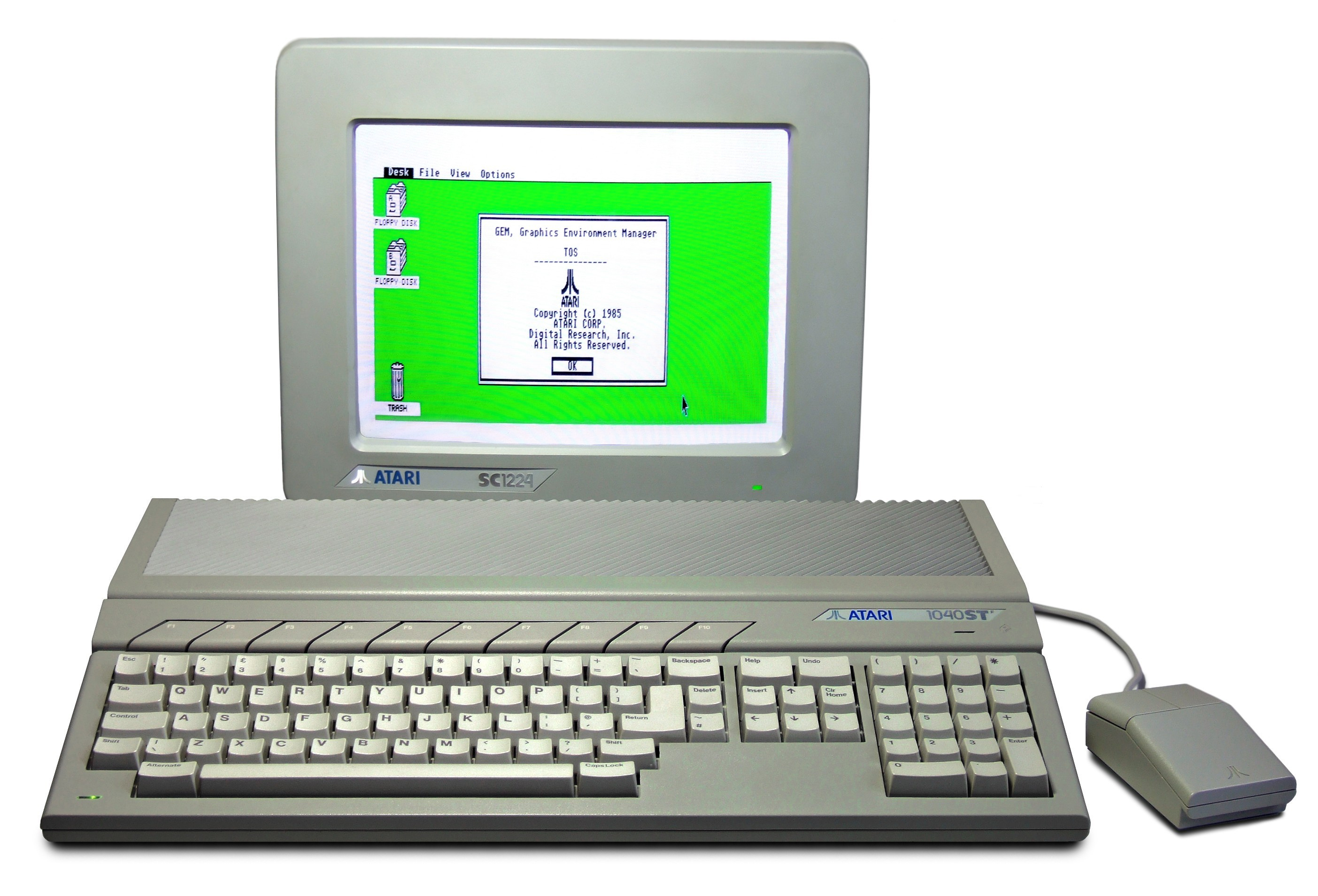

Exciting times
The 1980s was a great time for anyone interested in computers. There were rapid advances, and completely new models were being released regularly.
In 1985, the Atari ST was launched just before the Commodore Amiga. Like the Apple Macintosh from the previous year, all three featured the 68000 microprocessor and were classed as 16-bit machines.
The ST and Amiga had some advantages over Apple’s offering: they were cheaper and featured colour.
The name ST means Sixteen/Thirty-two. This refers to the fact that the 68000 chip has a 16-bit data bus, while being 32-bit internally.
With the ST being the cheapest, I imagined it might be the one I’d eventually choose to replace my Commodore 64. Despite it lacking the Amiga’s advanced custom chips for sound and graphics, it had much more to offer than the best 8-bit computers in most respects.

Amiga rivalry
It’s hard not to compare the ST and the Amiga, but the original Amiga 1000, with its separate keyboard, was in a much higher price category. Things started changing in 1987, when Commodore released the cheaper Amiga 500 model — and that’s when the rivalry really began.
In some ways, the ST vs Amiga arguments reminded me of the school playground rivalry I’d experienced between owners of 8-bit computers a few years earlier, such as the Sinclair ZX Spectrum, Commodore 64, BBC Micro, and Oric 1.
When comparing the Amiga 500 and Atari ST, it looks like Commodore copied the ST’s form factor. The two machines were of similar size and shape; both had a built-in keyboard and 3.5” floppy disk drive; and they were both supplied with a mouse. The two machines also shipped with either 512 KB or 1 MB of RAM.
However, the Apple IIc had a similar form factor in 1984 — one year before the ST.
At this point, I should point out that I bought an Amiga 500 in 1987. But I’ve tried not to be too biased against the ST in what follows!
GUI and operating system
Atari chose Digital Research’s GEM as the Graphical User Interface for the ST. Although GEM got the job done, I think it made the ST seem somewhat dull in comparison to the Amiga, which had its own unique “Intuition” GUI.
The ST also had a simpler underlying operating system. Unlike the Amiga, it didn’t support preemptive multitasking.
Speed advantage
As an Amiga owner, it always niggled me that the ST’s 68000 CPU ran at 8 MHz, making it about 13% faster than the Amiga.
That meant the Amiga simply couldn’t win when it came to CPU-intensive tasks. However, its custom chips usually gave it the edge with graphics and sound — especially if the software was well-written and not just a quick port from the ST.
Graphics
For graphics modes, the ST supported 320 x 200 in 16 colours, or 640 x 200 in 16 colours, from a palette of 512 colours. It also had a high resolution 640 x 400 monochrome mode, provided that a suitable monitor was available.
The Amiga offered more graphics modes and supported up to 32 colours from a palette of 4096 colours. It also had a special mode (HAM) which allowed all 4096 colours to be displayed at once, with certain limitations.
The Amiga could only match the ST’s high-resolution mode when using interlacing. Unfortunately, this resulted in flicker, unless a special “flicker fixer” add-on was used. To the Amiga’s credit, it did support up to 16 colours in that mode, whereas ST users had to make do with monochrome.
One of the Amiga’s custom chips included a blitter, which enabled fast line drawing and image manipulation with minimal help from the CPU. The original ST did not have a blitter, and — like the Apple Macintosh — it had to use the 68000 CPU instead, resulting in slower graphics performance.
Sound chip
Unfortunately, Atari only gave the ST a fairly simple 3-voice sound generator chip, making it similar to many 8-bit computers in sound capability. This is one area in which the Commodore 64, with its SID chip, was more capable.
The Amiga was much more advanced, with its custom sound chip capable of playing 4 channels of 8-bit sampled sound.
By using CPU-intensive code to manipulate its sound chip, the ST could be made to play samples of lower quality,
MIDI support
The ST had built-in MIDI ports, which made it popular with musicians who wanted to sequence music keyboards and synthesizers.
Because I chose the Amiga instead, I had to use an external add-on to do those things.
Later models
Following the initial 520 ST and 1040 ST models, Atari released some more advanced models in the ST range.
In 1987, the Mega ST had more RAM, a desktop case with separate keyboard, and an optional MMU (memory management unit).
In 1989, STe models brought significant hardware improvements, such as 4096 colours (up from 512), a built-in blitter chip for faster graphics, and support for sampled sound.
In 1991, the Mega STe, which combined the Mega ST and STe features and added further improvements, such as a selectable 16 MHz or 8 MHz clock speed.
Final thoughts
I don’t regret choosing the Amiga instead of the ST — it was the right choice for me at the time. But looking back now, I think I judged the ST rather harshly in the past.
It seems that the ST was also a very capable and deservedly popular machine.
Do you have memories of using the Atari ST? Please share your thoughts in the comments section below.
Thank you for reading!
~ Alan ~
Related articles
External links
This article was first published in 2018 on my former website, Jigsaw Mix. It was updated for Substack in 2025. In between, it has also been on Starchip Designs (Blogspot) and Medium.