
Remembering the BBC Micro
Personal reflections on a computer that was popular in UK schools during the '80s — and one that I longed to own

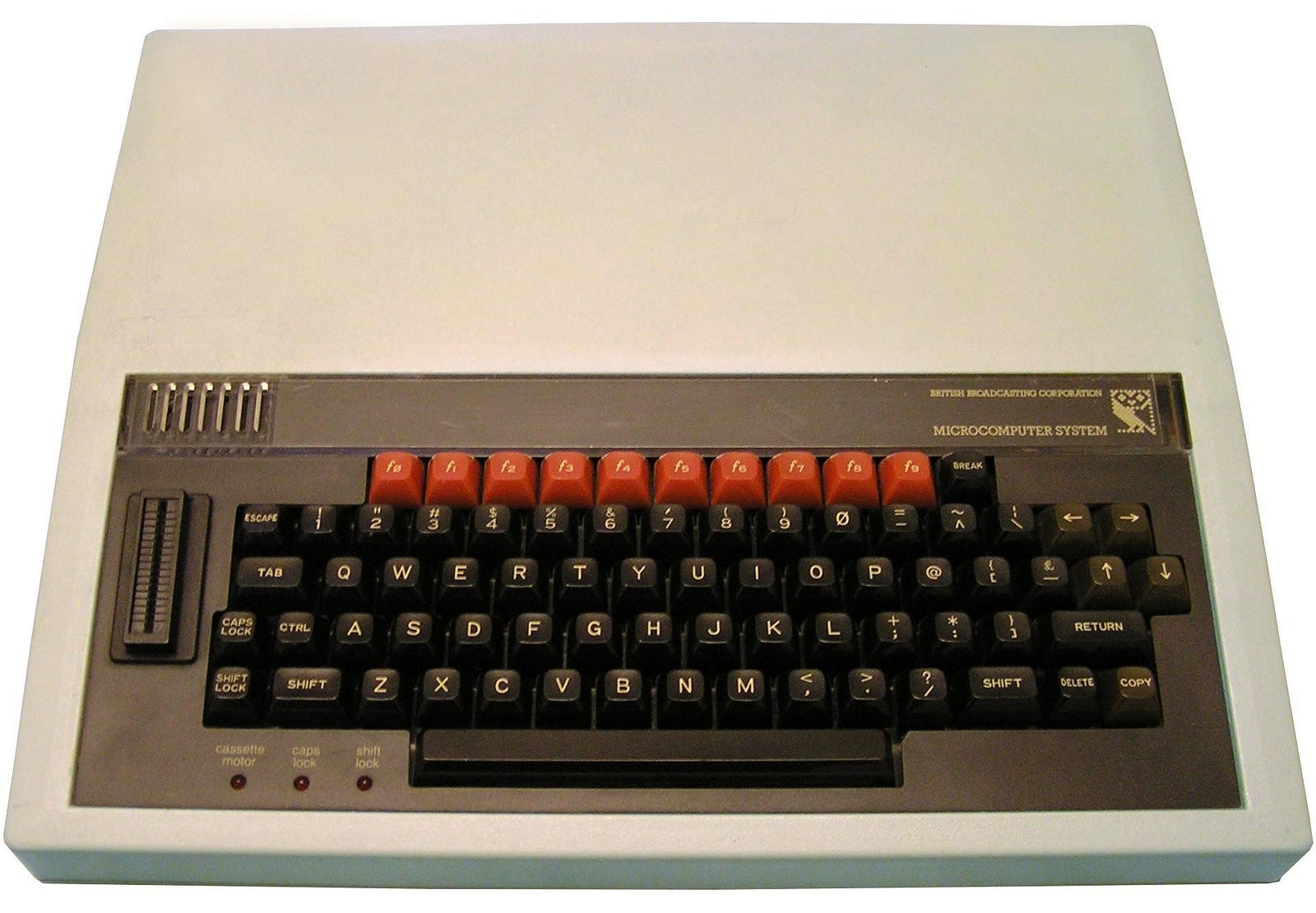

The BBC Micro was designed and produced by Acorn for the British Broadcasting Corporation’s Computer Literacy Project. It was released in December 1981.
After starting out with the Apple II, my high school computer studies class ended up with several BBC Micros as well, making it the second computer I ever used.
Even after the addition of the BBC machines, the class still wasn’t especially well-equipped, with about three pupils for every computer.
Above average specification
The BBC had a good keyboard and was a fairly sophisticated and well-specified machine.
With a 6502 microprocessor clocked at 2 MHz, it was also one of the fastest 8-bit computers at the time. (Back then, most other 6502-based systems were clocked at around 1 MHz.)
The BBC could store programs on tape, using an ordinary domestic audio cassette recorder. Alternatively, there was the option to add floppy disk drives; these were much faster and more convenient to use.
The machine featured a wide range of expansion ports, allowing an almost limitless variety of add-ons to be connected.
The downside of having all those features was the price — it was a bit too expensive for many parents to buy for their children, including mine.
Most of my classmates at school owned either a Sinclair ZX Spectrum, Oric-1, or VIC-20 instead. I only remember one person having a BBC Micro — he was an only child with affluent parents.
Hobby electronics
The built-in analogue and digital interfaces made the BBC a very convenient machine for those wishing to connect their own electronic circuits.
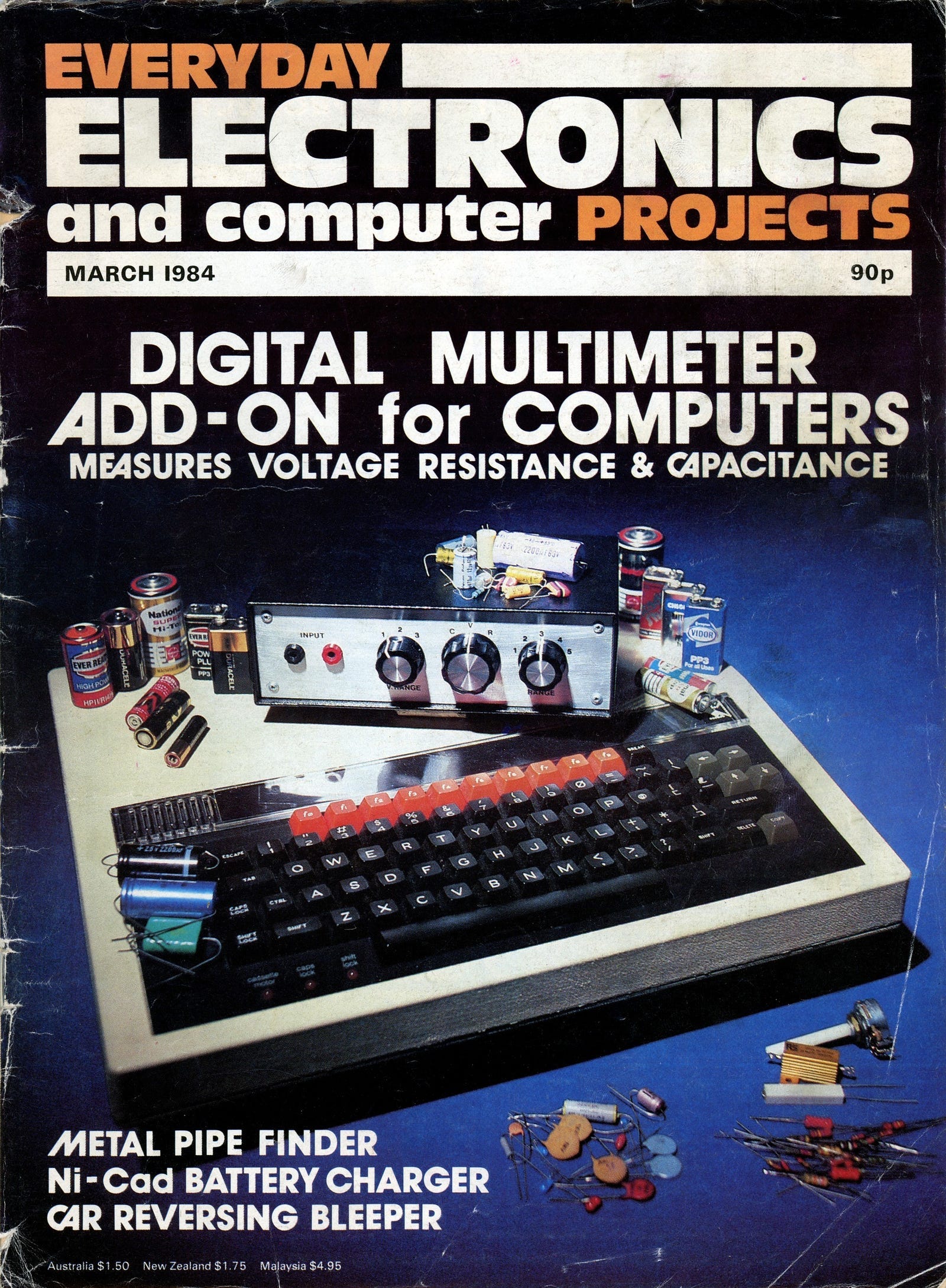
There were regular articles in magazines such as Everyday Electronics. Cheaper computers like the ZX Spectrum required more add-on circuitry to do similar things.
(As you can probably tell, I really wanted a BBC Micro back then!)
Good BASIC language
The BBC Micro had a relatively large 32 KB ROM. With a 64 KB address space, that meant RAM was limited to 32 KB in the model B. The cheaper model A only came with 16 KB of RAM.
Having a larger-than-average ROM meant plenty of room for a more sophisticated version of the BASIC programming language than its rivals. That made it possible to write well-structured programs at a time when BASIC on other computers often resulted in spaghetti-style code.
The BBC Micro also allowed other language ROM chips to be fitted, so it wasn’t just limited to BASIC.
I seem to recall it being somewhat difficult to find the information I needed in the user manual — but I suspect another pupil might have ripped out the contents and index pages!
Graphics
There were several graphics modes, offering a range of resolutions and colours, including 640 x 256 with 2 colours, 320 x 256 with 4 colours, and 160 x 256 with 8 colours. There were also text modes.
Fortunately, the BBC Micro’s built-in BASIC language had good support for graphics, unlike the Commodore 64 which I would later come to own.
I remember experimenting with the BBC’s line drawing functions at school and finding it significantly faster than the ZX Spectrum I owned at the time.
Fun with sound
As a child interested in music synthesis and sound effects, I enjoyed playing around with the BBC Micro’s sound generator.
With a 4-channel sound chip, it could produce three tones plus noise without keeping the processor occupied. That was far more impressive than my ZX Spectrum’s 1-bit sound. (Like the Apple II, that machine required the processor to generate every pulse.)
As with the graphics, the BBC’s built-in BASIC also had good support for its sound generator. Again, that made it much easier for beginners to program compared with the Commodore 64.
I remember experimenting with the SOUND and ENVELOPE commands during a computer studies lesson.
The usual teacher was not in on that day, and the history teacher was standing in. He admitted that he knew nothing about computers — but he did start to get suspicious when all kinds of strange sounds were coming from the computer I was using…
TV shows
In the early ‘80s, the BBC made TV programmes such as The Computer Programme and Making the Most of the Micro, both of which featured the BBC Micro.
Watching those shows in recent years never fails to take me back to my childhood. Most of them can be found on YouTube — I’ve included some links at the end.
Related computers
Acorn, the company behind the BBC Micro, also made a cheaper machine called the Electron, but it didn’t really appeal to me. Despite the Electron having some compatibility with the BBC Micro, it had a poorer specification — e.g. it ran slower and had only one sound channel.
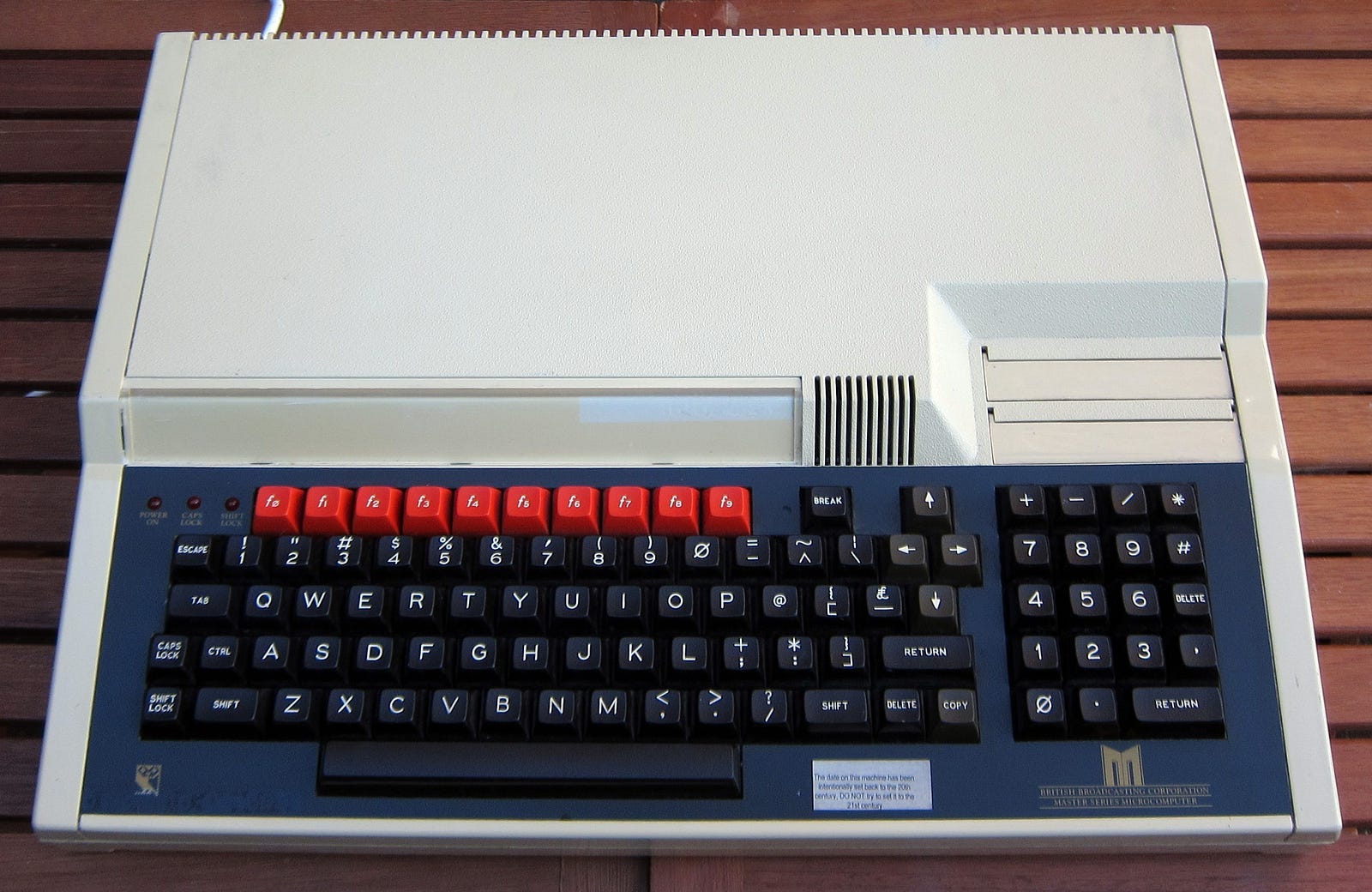
After the BBC Micro, more advanced machines followed, such as the BBC Master, which had 128 KB of RAM. Acorn also went on to develop the ARM processor, which they used in their Archimedes computers.
(Most modern smartphones use newer versions of the ARM CPU core. Some of the initial development work on the first ARM chips was done using BBC Micros fitted with a second 6502 CPU running at 3 MHz. Source: Personal Computer World magazine, November 1985.)
Final thoughts
During my school days, the BBC Micro was a machine I longed to explore in detail. Unfortunately, that never happened because computer time at school was limited and it was too expensive as a home computer.
Although I’ve never owned a BBC Micro, my late wife Marie bought me one of the newer BBC Master computers a few years before she died.
Sadly, I’ve never given myself the time to do much with it, other than running the classic game Elite, or typing in a few short programs on the keyboard to remind myself of my school days; it has the same feel as the original.
Every so often, I agonise over whether to sell my BBC Master 128.
Do you have memories of using the BBC Micro? Please share your thoughts in the comments section below.
Thank you for reading!
~ Alan ~
Related articles
External links
Videos
Articles
This article was first published in 2018 on my former website, Jigsaw Mix. It was updated for Substack in 2025. In between, it has also been on Starchip Designs (Blogspot) and Medium.